BMX & Dirt Bikes — Small Wheels, Big Impact!
Since the movie BMX Bandits from the 80s, BMX bikes have become part of pop and sports culture. Thanks to their extra stable construction – often steel frames and 20-inch BMX wheels – BMX bikes, which have been reduced to the bare essentials, make it possible to perform stylish tricks on streets and dirts. Even today, BMX and dirt bikes have a loyal fan base and are very popular with the little heroes of tomorrow with 16 and 18-inch BMX wheel sizes. Whether you want to buy a BMX bike for kids, a dirt jump or a freestyle BMX, a great selection and a fast delivery await you.
What Are the Differences between a BMX Bike and a Dirt Bike?
If you want to perform stylish tricks on your bike in the park, fly over ramps or turn the architecture of the city into your playground, there's no getting around a BMX or dirt bike. But what are the differences between the two types ? BMX and dirt bikes can be easily distinguished from each other by their wheel size and components.
What Makes a BMX Bike
BMXs with 20-inch rims are aimed particularly at teenagers and adults. However, 16 and 18-inch are also used for kids' BMX and dirt bikes for children. In general, all BMX bikes have a particularly stable and compact frame, a raised handlebar, no suspension or shifting and a brake is often only mounted on the rear wheel. This makes a BMX especially solid, relatively inexpensive and stress-free in terms of maintenance – less parts, means less chance for breakdowns. The compact size of a BMX makes demanding tricks easier – whether in the miniramp, the bike park or flatland on a parking area. In addition to tricky BMX freestyle, the small bikes are also used in BMX racing competitions on the pump track. This discipline is even an Olympic event, and BMX was originally invented for this purpose. By the way, this was back in the 1960s – making the BMX significantly older than the dirt bike or any mountain bike.
What Makes a Dirt Bike
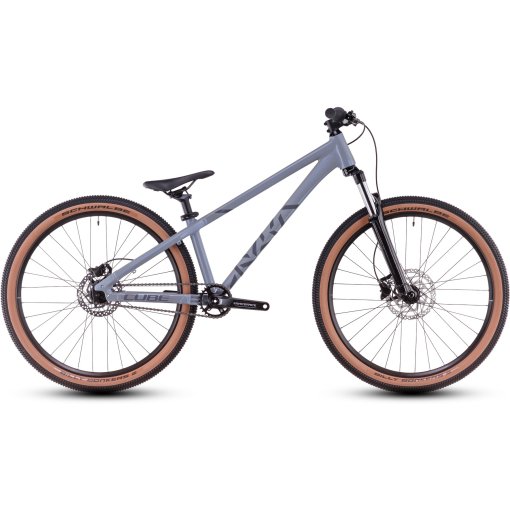
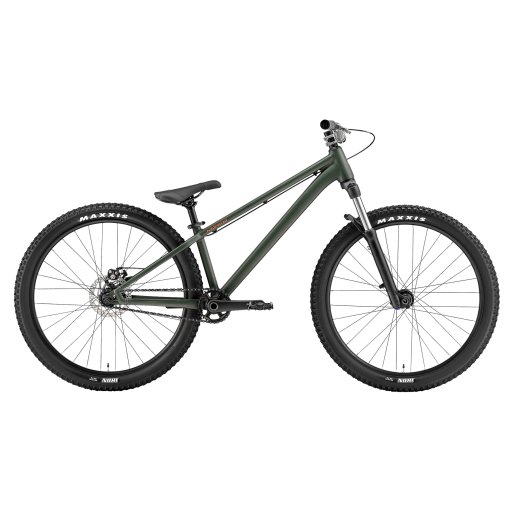
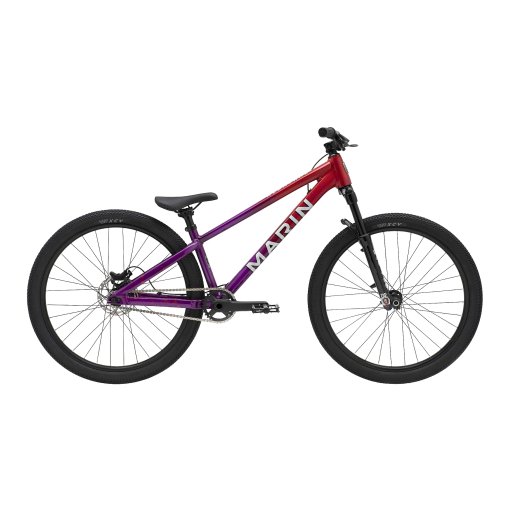
Dirt bikes with 26-inch wheels – sometimes also 24-inch – are basically based on the MTB hardtail. However, all parts on the dirt bike are designed for maximum stability so they can withstand the high loads on the slope line in the bike park. Dirt bikes have a suspension fork with around 100 millimetres of travel, usually no shifting (if at all, then only a rear derailleur on the rear wheel), and disc brakes (sometimes only a disc brake on the rear wheel). In addition, special dirt or BMX tires with narrow tire carcasses and negative tread or smaller studs are used for rolling characteristics with good grip. The frames with a steeply sloping top tube are very compact, but due to the wheel size, a dirt bike is larger overall and, above all, longer than a BMX. This results in the range of use: with a dirt bike, you can ride at higher speeds and make much bigger jumps in the bike park. However, you can also have fun with a dirt bike downhill on an MTB trail or while freeriding.
BMX Bike vs. Dirt Jump Bike
Here you can get a quick overview of the differences between the two types of bike:
| BMX Bike | Dirt Bike |
|
|
What Is Important When Buying a BMX Bike?
With BMX, you first have to decide whether you want to ride race or freestyle. In a BMX race, you ride on a pump track with tight berms and jumps at maximum speed. Several athletes compete against each other at the same time. That's why a race BMX needs to be as light as possible and usually has an aluminium frame. It also needs a brake on the rear wheel.
In BMX freestyle (which includes the flatland, park and dirt disciplines), it is important that the handlebars can be turned a full 360 degrees for tricks. You also need so-called pegs on the hubs axles of the front and rear – these are bolt-on extensions of the axle on which you can stand or support the bike when performing tricks. Freestyle BMX bikes often come with steel frames, but aluminium is also common.
It is important to know that BMX bikes are fitted with many special components that do not fit on any other bike. BMX handlebars, BMX stems, BMX saddles or seatposts and wheels have their own dimensions and mounting dimensions. BMX pegs and grips are primarily tailored to the needs of BMX dudes.
By the way: You can also find a large selection of suitable parts for your BMX in our range.
Buy a Dirt Bike – What You Need to Look out For?
The dirt bike is basically a hardtail with maximum stability. This means you can score points in slopestyle with cool combos, but also start freeride action on trails. The frames and components are all extremely stable and can easily withstand a rough landing or a fall.
If you will be riding your dirt bike primarily on rougher surfaces, make sure you have tires with good grip that offer enough support in corners. If, on the other hand, you mainly want to ride on hard surfaces, then tires with a low tread roll better. If you also intend to do tail whips and similar tricks when jumping, make sure that the handlebars can be rotated 360 degrees. Similar to their 20-inch BMX counterparts, dirt jump bikes are therefore almost always ridden without front brakes.
What Additional Equipment Do I Need for a BMX and Dirt Bike?
BMX and dirt bikes are strongly oriented towards the style of the skater and street scene. That's why there are special accessories for the sport. The sleek, cool BMX helmets are especially eye-catching and are also popular among many urban bikers. Protectors are highly recommended for dirt bike riding. Casual freeride style is the order of the day when it comes to clothing. You can also find a large selection of suitable flat pedal shoes for the BMX pedals in our onlineshop.
Buying a BMX Bike and Dirt Bike Online
Now you're ready to choose your new BMX or dirt bike for your next session. In case you have missed something, we have summarized the most important points for your purchase:
- BMX and dirt bikes are stable, simply constructed bikes for tricks, the park and the pump track.
- Which bike you need depends largely on your personal preferences and the intended use.
- With its smaller wheels, compact frame and minimal equipment, the BMX is lighter and easier to handle.
- Ideal for tricks on ramps and in the park, but also for racing on the pump track.
- The dirt bike is more or less an extremely stable hardtail.
- With suspension fork, disc brakes and very stable components and smooth running, it is suitable for fat jumps in the park, but also for freeriding on technical trails.